
“You really need failure to learn and kick back against. [In a world without failure] my art would be really similar, but perhaps more playful in subject, often larger, kinder to my hands and more considered. Maybe I’d live in America, too. That’s where the excess lies.”
Daniel Howden
The following interview forms part of a series where I invite contemporary artists to each reflect on their personal history, meaning, and philosophy, and how those are embedded throughout their creative process.
This week, I talk to Daniel Howden, an illustrator and printmaker from York who specialises in architectural prints using reduction linocuts. In 2011, he first encountered lino before developing and enhancing his layering techniques: cutting the linoleum into a jigsaw-like state, then piecing it back together to form an image, using 30 to 90 reductions – a method which earned Daniel the Anthony Dawson Young Printmaker of the Year award in 2016.
Tell me about your piece, ‘Monolith II’.
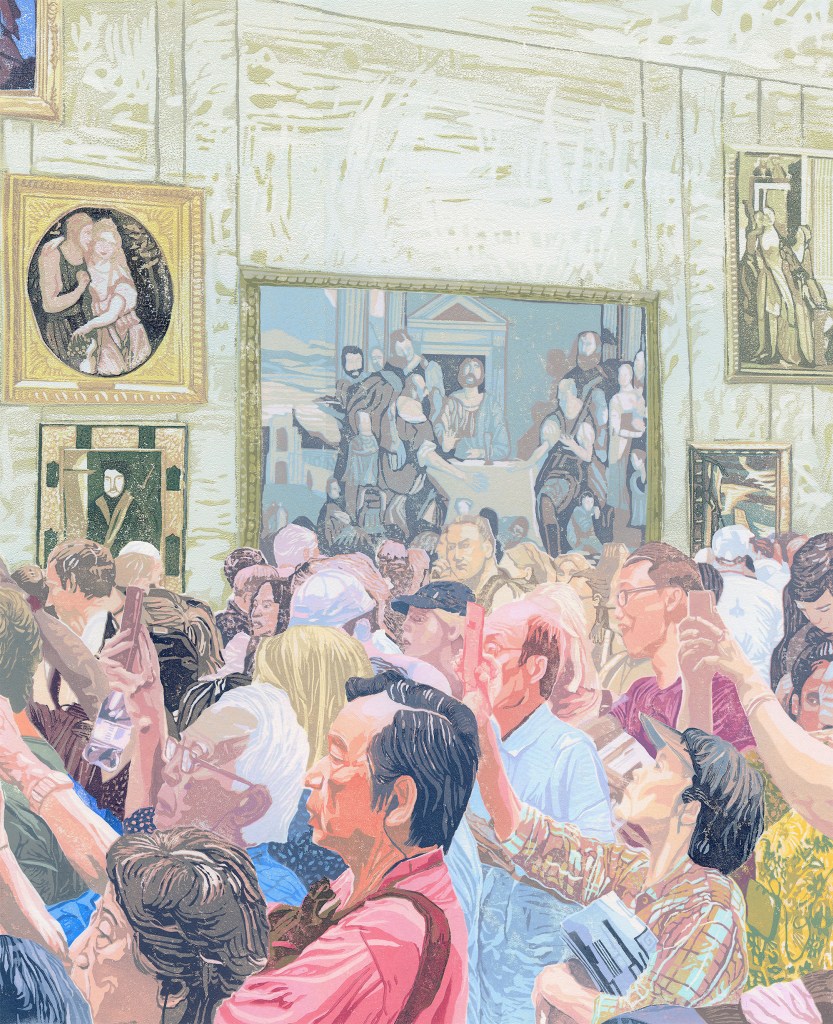
Monolith II is a lot of things. I guess first and foremost it’s a reduction linocut of a photo I took at the Louvre a little while ago. As an exercise, it’s the largest piece I’ve done to date (56x40cm) and it took two months to complete, which is the longest I’ve spent printing by some stretch. It’s made up of 442 registrations, which if you times by nine (the number of editions I made), means I rose out of my chair, picked up a print, rolled ink and held my breath around 3978 times – which is very unhealthy, in hindsight.
Before this print, I’d been desperate to challenge myself and work on a larger scale for years but I never really operated in a big enough space. In addition, the type of linoleum I use doesn’t exceed 40x30cm which is why my work is usually 30x30cm. I kept revisiting the idea enough, though, that I finally caved and just superglued two blocks together in January 2022, removed everything from my desk and gave it a shot.
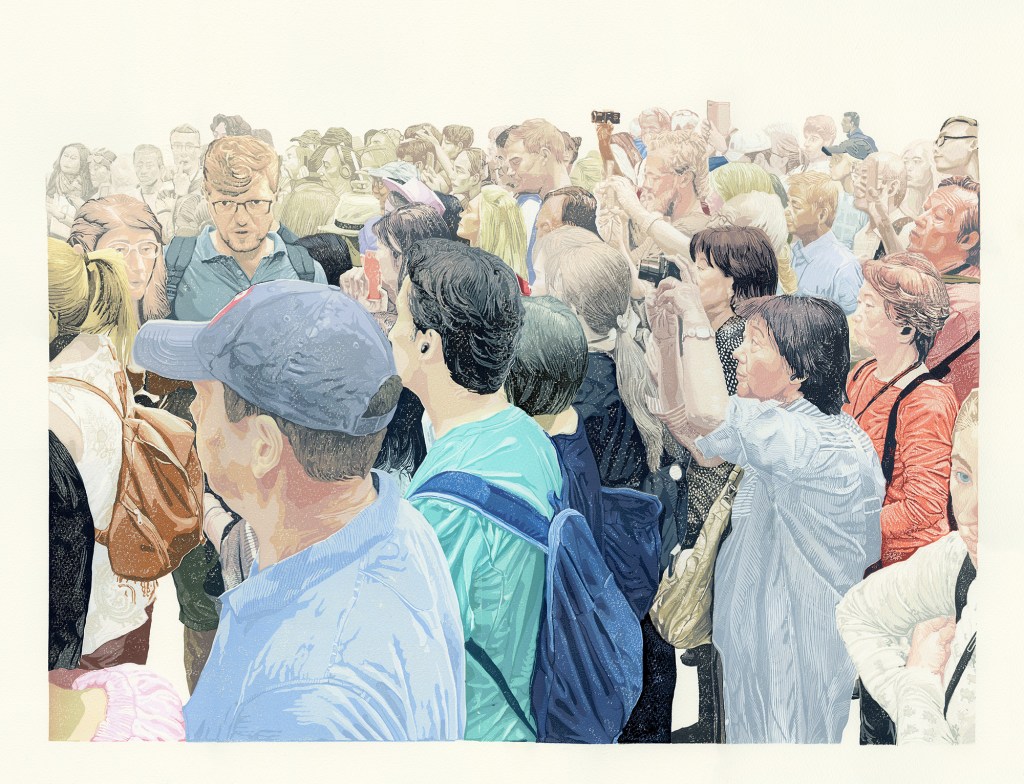
Technicalities aside, my reasoning for blowing up this particular image is that I’m specifically interested in compositions that are congested and excessive, and if the objects within it are all the same, even better! That’s a bonus point to me.
I think when I took the photograph in 2018, I was quite taken aback by the crowd clamouring from a glimpse of something, but scenes like that are a bit more ubiquitous these days and so I guess I chose it more for its literal contents. A case study.
Some of my favourite things to print are fabrics, faces and plastics. Down the years I’ve found these elements really lend themselves to the way I layer ink and carve – so this particular print was kind of a feast, in that regard.
Is there a sense of how your artistic process influences your way of experiencing the world, just as it might influence the other way around?
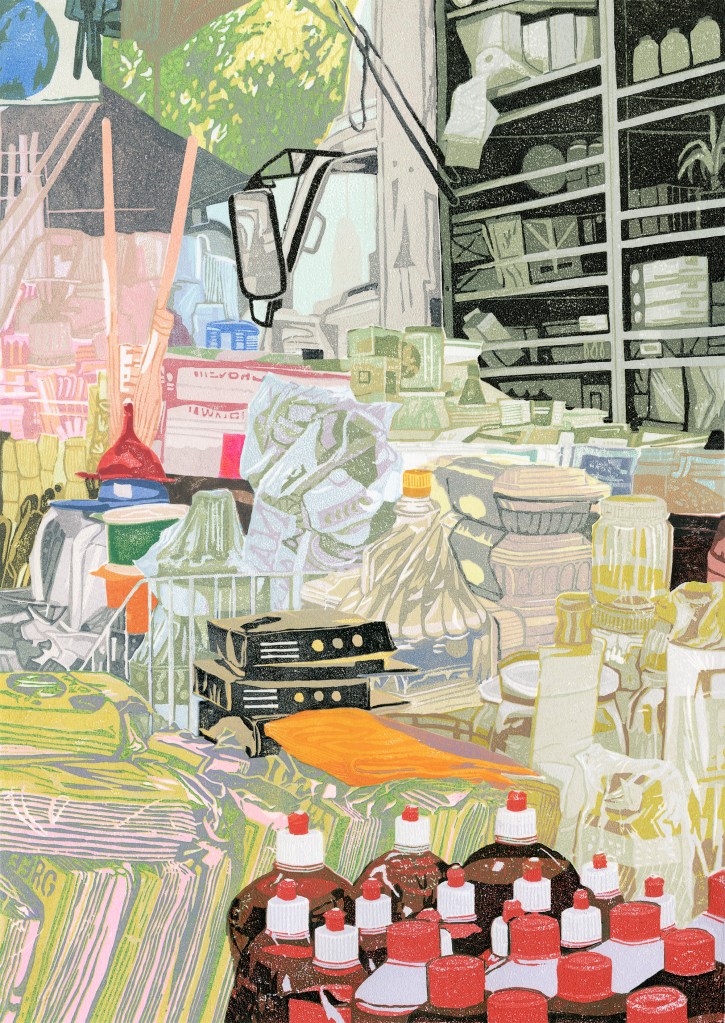
Absolutely, there’s that duality. Growing up I alienated quite a few friends as I was always recording everything on my iPod touch. I never wanted my photo taken, and so instead I decided I would do that for everyone else. I recorded people being silly and I documented everything that we did. I see now how it was probably overbearing for those around me, but I knew they’d all appreciate it later. I worked on a lot of building sites growing up, too. I think these two aspects of my life, though separate, have certainly influenced my art – I have an eye for anticipating certain things and my love of construction materials and temporary infrastructure is a huge influence.
I’ve always worked from my own photographs (with a couple of exceptions here and there) and so my practice is totally reliant upon excursions, leaving the house and capturing things at opportune times. I have to seek out the things I want to print and therefore image gathering is *the* most important aspect of my process and whenever I’m outdoors there’s always a little pressure to capture something interesting should it appear, sometimes to the detriment of conversations.
I started practicing linocut in 2012 and over the last ten years I’ve developed a rather astute compositional gauge (lino vision) of what works and what doesn’t for when I’m out speculatively looking, which I sort of lay over things as I view them.
I was travelling with my partner over the summer and we happened to be in Paris as the Tour de France came through. We separated for a few hours and when we met back up she told me how I’d missed a procession of inflatable advertisements being driven around the route. I was crushed. I spent an hour trying to find them in the heat, but to no avail. Little instances like that are quite common. Whilst out there I went in search of community gardens to photograph and there was an obligatory pause for photographs whenever we walked past a cluster of portacabins, too. She would cross the street or slowly carry on ahead depending on her level of embarrassment, we have a sort of shorthand, and then we reconvene a little later. Little things like these certainly have an effect on how I interact with the world around me. Doing lino has really maintained my curiosity.

As an artist, how can one talk about certain subjects without being too on the nose or disingenuous?
I think when starting any new piece of work, especially if you’re handling something sensitive, there’s a responsibility to consider the best approach and apply a critical framework to the ideation process. Whether you’re able to really give an honest critique yourself or instead seek the opinion of a few reliable people, I think it’s always sensible to ask questions early on like: Who is the audience? Why am I doing this? What new perspective am I bringing? and Is it my story to tell? It might be as simple as just not talking about something via your art, if finding an entry point is proving difficult. Just because it’s your medium, doesn’t mean it’s always the vehicle to communicate a message via.
Poet Rainer Maria Rilke wrote, “A work of art is good if it has arisen out of necessity.” How does this resonate with you?
Considering that was said a century ago, I don’t think it can be applied in this day and age. It’s a totally different world. That being said, if we’re in agreement that ‘necessity’ means ‘essential’ or ‘required’, a huge pool of artists today would be making ‘bad’ art under that criteria. Art doesn’t strike me as something you do out of necessity. If you make art solely to make money, I guess that could be deemed essential to the artist under those circumstances. But then is that ‘good’ art? I’m not convinced. It’s all subjective, but that’s a very blanket statement and I’d diplomatically agree to disagree.
What role does your relationship with yourself play in how you create art?
Until this year, I’ve never really had much of a handle on self care since I started university in 2012. At the beginning, the lack of structure in my life and the fulfilment I got from working, meant that lino, this exciting new thing, often eclipsed everything else and I was probably the most productive I’ve ever been. Looking back, that period really gave me a firm foundation to work from and accelerated my ability by cramming so much in, but it also set a really unhealthy precedent. There was a block of about 4 years after graduating in 2015 where I would forget to eat and drink and struggled to maintain many relationships due to the sheer amount of work I set myself in order to improve and get to where I needed to be.
Right now I’m trying to create a more even and kind balance where both parties are satisfied.
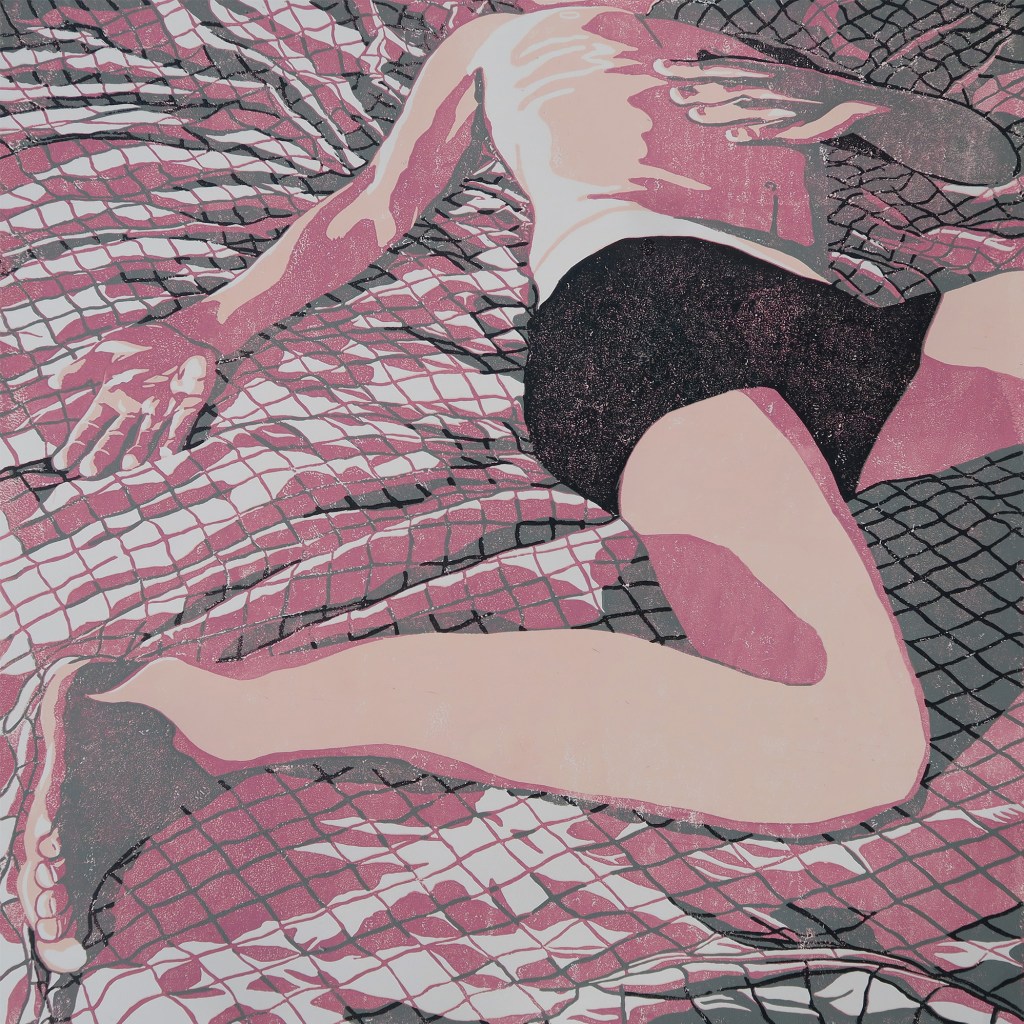
My relationship with myself is possibly more present within the art than I realise, but not enough for me to draw any strong parallels. Lino offers a form of escapism for me and I like to keep the two separate and in doing so, lighthearted. The only instance of the two combining was a print I did in 2018 called Summer Duvet. I fondly remember the print getting a warm IG reception (by my own metrics) and I was really satisfied with the end result, except the final black layer – way too harsh. Around that time I was having a really hard time with body image and I felt compelled to highlight that. It took shape very quickly, was completely instinctive and hasn’t happened since. But that feels right. It needed to come out.
In a world where failure was impossible, how might your art be different, if at all?
I’m not a million miles away. It’s a process. You really need failure to learn and kick back against. My art would be really similar, but perhaps more playful in subject, often larger, kinder to my hands and more considered. Maybe I’d live in America, too. That’s where the excess lies.
Learn more about Daniel Howden and keep up to date with upcoming exhibitions: https://linktr.ee/Dan.Howden

 repsychl